

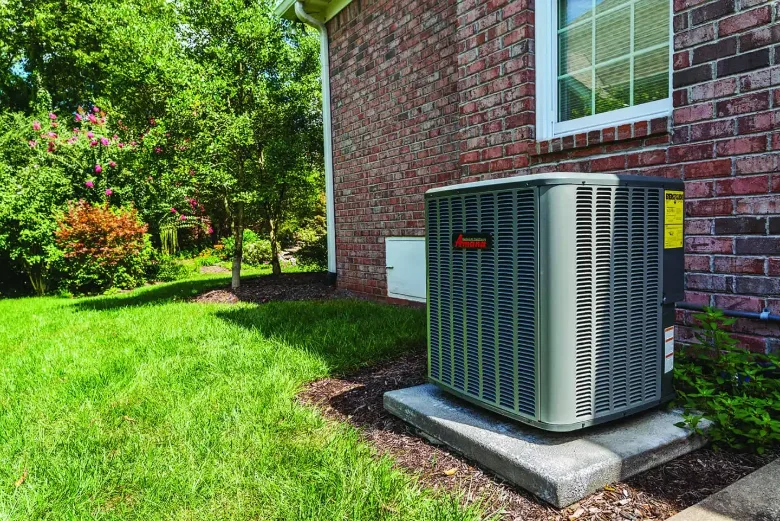
If you’re replacing your AC in North Texas, there’s a decision hiding inside that quote that a lot of contractors don’t bother explaining clearly: what kind of compressor do you actually want?
The three options are single-stage, two-stage, and variable-speed. Most homeowners never hear about the middle one, and most get pushed toward whichever one earns the rep the bigger commission. We’re going to lay it out honestly — including when the cheaper option is genuinely the right call.
The Short Version
- Single-stage runs at 100% or off. Cheapest to buy, simplest to fix, cools your house fine.
- Two-stage runs at roughly 65% most of the time and 100% when it needs to. Middle ground on price and comfort.
- Variable-speed runs anywhere from ~25% to 100% and adjusts continuously. Most expensive, most efficient, best humidity control.
If you want one sentence: single-stage is the workhorse, variable-speed is the dimmer switch, and two-stage is the compromise most homeowners forget exists.
How Each One Actually Works
Single-Stage: On or Off
A single-stage compressor has one speed — full blast. When your thermostat calls for cooling, it ramps to 100%, cools your house down past the setpoint, then shuts off entirely. When the temperature drifts back up, it kicks back on at 100%.
This is the technology most homes in Garland, Mesquite, and across DFW already have. It’s been the industry standard for decades because it works, it’s reliable, and the parts are cheap and plentiful.
The tradeoff: The on/off cycle creates temperature swings. You get a blast of cold air, the system shuts off, humidity creeps back up, and by the time it kicks on again you’re already uncomfortable. That cycle also uses the most electricity at startup, which is why single-stage systems tend to have higher operating costs than the spec sheet suggests.
Two-Stage: High and Low
A two-stage compressor has two settings: about 65% capacity and 100% capacity. Most of the time it runs on the low setting for longer, gentler cycles. On a 105-degree DFW afternoon, it ramps up to full power to keep up.
This is the option most homeowners never hear about, which is a shame because it’s often the sweet spot. You get noticeably better humidity control and more consistent temperatures than single-stage, at a price that’s usually only a few thousand more rather than the big jump to variable-speed.
Variable-Speed: Continuous Modulation
A variable-speed compressor (sometimes called “inverter-driven”) can run at any capacity between roughly 25% and 100%. Instead of cycling on and off, it runs almost constantly at whatever speed matches the current cooling load.
On a mild 85-degree morning, it might hum along at 30% all day. On a brutal 108-degree afternoon, it ramps up. The result: rock-steady indoor temperatures, excellent humidity removal, and significantly lower energy use over a season — because the system almost never has to do the expensive high-power startup cycle.
What This Actually Means for a DFW Home
Here’s where most comparison articles stop being useful. They give you the technology breakdown and leave you to figure out which one fits your house. In North Texas specifically, a few things matter more than they would elsewhere.
Humidity is a real problem here. DFW summers regularly run 60–70% relative humidity indoors if your AC is oversized or cycles too quickly. Single-stage systems can make this worse because their short cycles don’t give the coil enough runtime to pull moisture out of the air. Variable-speed systems are dramatically better at this. Two-stage is somewhere in between.
Our cooling season is long. From May through September, your AC is working hard. That’s five months of runtime where efficiency gains from variable-speed equipment actually add up. In a milder climate, the math on the upgrade doesn’t work as well. In DFW, it often does — if you’re staying in the house long enough to capture the savings.
Electricity rates in our region reward efficiency. Depending on your provider, you’re paying somewhere between 11 and 16 cents per kWh. A variable-speed system running 30–50% more efficiently over the course of a Texas summer translates to real dollars off your bill, not a rounding error.
Sizing matters more than stage count. We can’t say this strongly enough: an oversized single-stage system will be more uncomfortable than a correctly-sized one, period. And a variable-speed system installed on a duct system that can’t handle it will never perform to spec. Before you agonize over stages, make sure whoever’s quoting you is doing actual load calculations and not guessing based on square footage.
Who Should Buy Which
Single-stage makes sense if:
- Your budget is tight and you need to get AC back in the house now
- You’re planning to sell the home in the next few years
- You have an older duct system that hasn’t been evaluated for higher-end equipment
- You’re replacing a rental property AC
There’s nothing wrong with a single-stage unit. We install them all the time, and they cool houses just fine. Don’t let anyone shame you into an upgrade you don’t want.
Two-stage makes sense if:
- You want meaningful comfort and humidity improvements without the top-tier price
- You plan to stay in the home for 7+ more years
- Your ductwork is in reasonable shape
- You want the efficiency gains to pencil out in a reasonable timeframe
This is honestly where the best value sits for most DFW homeowners we work with.
Variable-speed makes sense if:
- You’re staying in the home long-term (10+ years)
- Humidity and hot spots are a current problem you want solved
- You value quiet operation and rock-steady temperatures
- You have or are willing to upgrade to ductwork and an air handler that can actually support it
- The upfront cost difference doesn’t hurt
Variable-speed is the best equipment. It’s not the best purchase for every house.
What’s Going to Push the Price Around
Beyond the stage count itself, a few things affect what a new system actually costs:
- SEER2 rating — higher efficiency adds cost, and it’s not always about SEER2 alone in our climate
- Refrigerant transition — the industry moved to R-32 in 2025, so new equipment pricing reflects that
- Matching furnace or air handler — variable-speed compressors usually need a matching variable-speed blower, which can force a full-system replacement
- Ductwork condition — undersized or leaky ducts will kneecap a premium system
- Rebates — Garland Power & Light offers up to $1,000 through the EnergySaver program on qualifying full system changeouts (15.3 SEER2+)
The Honest Bottom Line
If someone quotes you a variable-speed system without ever asking how long you’re staying in the home, what your ducts look like, or what your current humidity problem is — that’s a sales pitch, not a recommendation.
The right answer for your house depends on your budget, your timeline, and what’s actually wrong with your current comfort. A good HVAC contractor will help you figure that out before they hand you a price sheet.
Need an honest comparison for your home? Our technicians are salaried, not commissioned — so when we recommend a stage, it’s because it’s right for your house, not because it pays us more. Get a free replacement estimate or call us at 469-905-4822.
You can also get an instant ballpark quote online if you want to see numbers before booking a visit.
